

Wir möchten Dich hier darauf aufmerksam machen, dass nicht für alle Paare jede Zusatzleistung notwendig ist. Wir gehen individuell auf Eure Situation ein und empfehlen die Methoden, die in Eurem Fall die Chancen auf eine Schwangerschaft erhöhen könnten.
Additional services
 Additional services for you
Additional services
In long-term culture, your embryos are observed for five days until they reach the blastocyst stage.
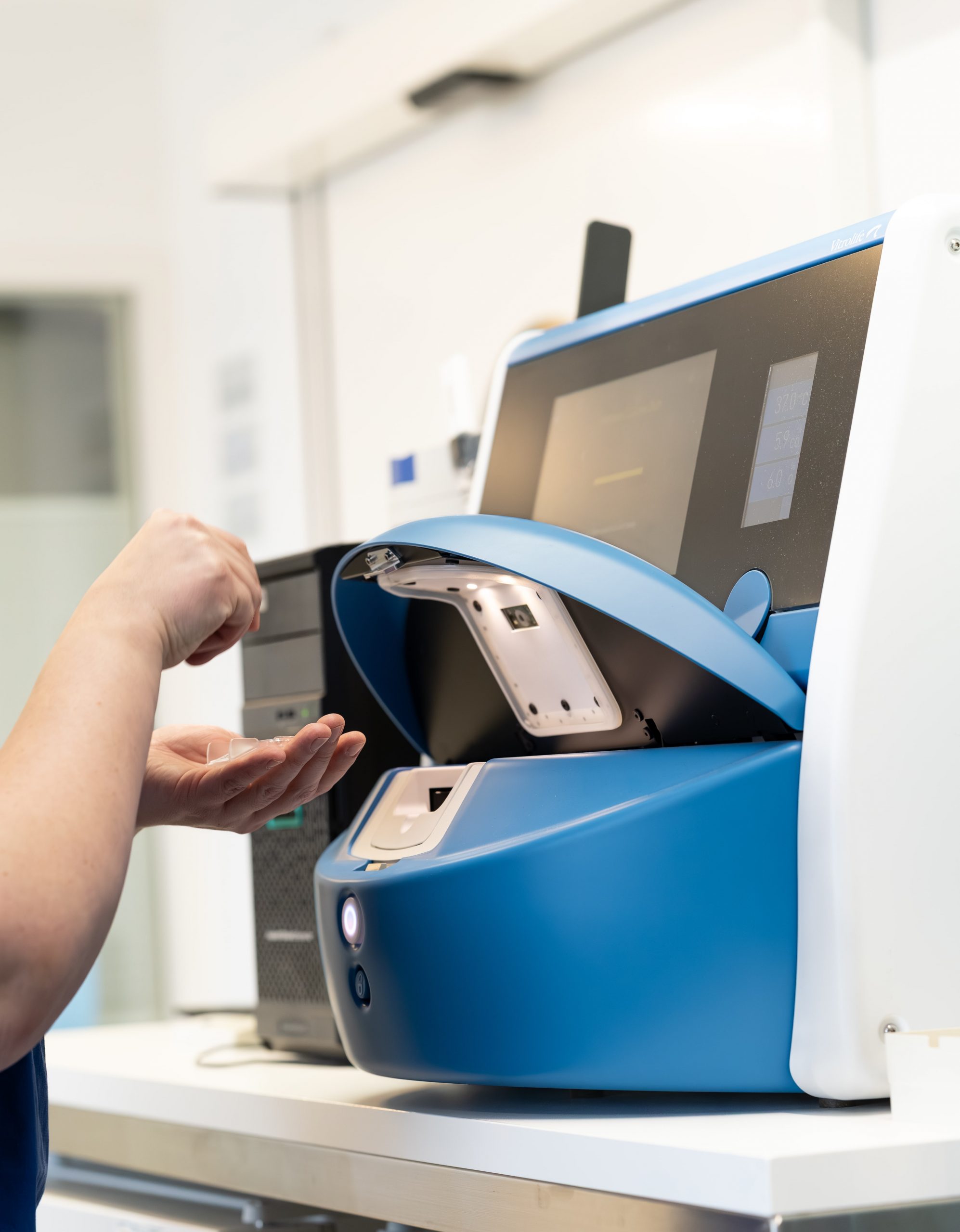
What is the Embryoscope?
The Embryoscope is an incubator with an integrated camera. All fertilized eggs are photographed at short intervals during their stages of division. Normally, the dishes containing the embryos are removed from the incubator several times for observation in order to assess their development. With the Embryoscope, this is no longer necessary.
What are the advantages of the Embryoscope?
- It provides more information about the quality of the embryo.
- It provides all the necessary data on embryonic development.
- During embryo development, the embryo is protected from exposure to white light.
- It provides the embryos with a safe and optimally adapted environment in which they are not influenced by the external environment.
- The images from the embryoscope enable continuous observation of the division and facilitate the assessment of the development potential of the resulting embryos.
EmbryoGlue is a medium specially developed for embryo transfer, which provides additional support for embryo implantation. It contains hyaluronic acid and has been shown in large studies to improve embryo implantation.
NEW! Performed in the in-house IVF laboratory at Kinderwunsch Bodensee
The Principle of DNA Fragmentation
Impaired or failed fertilization following assisted reproduction, or embryonic developmental abnormalities, may be associated with sperm DNA fragmentation.
This means that the higher the proportion of sperm with DNA fragmentation, the lower the likelihood of a successful pregnancy. To measure the proportion of sperm with defective DNA, the sperm DNA is analyzed using the Sperm Chromatin Dispersion Assay (SCD).
What do the latest studies say?
The latest research suggests that an elevated sperm DNA fragmentation rate can negatively impact both fertilization rates and embryonic development, as well as miscarriage rates (Jiang et al. 2025; Hong Yu et al. 2025; Krog et al. 2023; Li et al. 2024). These studies increasingly highlight recurrent miscarriages as a possible consequence of high DNA fragmentation. Thus, the latest findings indicate that male factors must be examined more closely, as they may have a greater influence on the likelihood of pregnancy than previously assumed.
How is the procedure carried out?
- Schedule an appointment for semen collection
- Semen collection must take place at the clinic
- A 1–2 day abstinence period must be strictly observed
- A standard semen analysis can be performed concurrently
What is the result?
Once the percentage of sperm with DNA fragmentation has been determined, an adjusted treatment approach—the use of a ZyMōt chamber—can be developed if the fragmentation rate is elevated. The ZyMōt chamber procedure is also performed in-house at our fertility center and can be used during the next IVF/ICSI cycle following planning.
In addition, it is advisable to review your lifestyle and make improvements where necessary.
NEW! Performed in the in-house IVF laboratory at Kinderwunsch Bodensee
The ZyMōt® chamber is an innovative method of sperm preparation. The selection process is modeled after the natural fertilization process in the female reproductive tract.
Only high-quality sperm are capable of passing through the chamber. Sperm are thus selected based on their motility, morphology, and maturity. Sperm with high DNA fragmentation can also be filtered out. (Study: Quinn et al. 2018)
The individualized use of the ZyMōt® chamber can improve outcomes following IVF/ICSI. Studies show an increase in blastocyst and pregnancy rates (Melnick et al. 2018, Gode et al. 2019).
When is the ZyMōt® chamber used?
The chamber is a therapeutic procedure used when elevated DNA fragmentation is detected. Immediately after sperm collection, processing with the ZyMōt chamber takes place in preparation for the subsequent IVF/ICSI treatment.
Are there any potential risks?
None

 Possible treatment options
We find a suitable therapy for almost every diagnosis
As soon as all the test results are available, we will discuss the various fertility treatment options with you. We take the time to explain all the options to you in a way that is easy to understand, including the chances, risks, and special features. This allows us to choose a treatment path together that suits you: as targeted, as gentle, and as pleasant as possible on the way to your long-awaited pregnancy.
Cycle monitoring
Insemination (IUI)
In-vitro-Fertilisation (IVF)
Intracytoplasmic sperm injection (ICSI)
Social Freezing
Medical Freezing
Additional services – long-term culture, embryoscope, Intralipid, and much more
Online intake: Fill it out from homeBook an appointment
Our work in figuresSuccess statistics
43
35
31



I would like to thank you from the bottom of my heart for your dedication and professionalism. After such a long wait, I can finally hold my baby in my arms thanks to you. She is now 3 months old. You are the best. Success on the first try. Highly recommended. Very good and dedicated doctors. Thank you, see you soon.
We can recommend the clinic 100% and say, get help promptly and don't wait. We had years of trying unsuccessfully to have children. Then we went to the clinic. It was a real relief. Our starting position was as bad as it could be. And yet it worked on the second attempt. Without the Bodensee Fertility Clinic, we would never have become parents to a wonderful boy. We found the support and care provided by the entire team to be very warm and empathetic. We also found the balance between justified hope and realistic medical assessment to be very good. Costs were communicated transparently and not artificially inflated. We always had a choice. A top clinic!
I would like to express my heartfelt thanks to you today! Thanks to your support and the empathetic treatment provided by Dr. Simon and Dr. Heine, I am now delighted to report that I am 19 weeks pregnant. We are overjoyed and sometimes still cannot believe our luck. After all the hopes, doubts, and the long journey, this dream has finally come true—and that would not have been possible without your competent, loving, and patient care. I would especially like to express my sincere gratitude to Dr. Simon. Your empathetic manner, patience, and commitment have given us courage time and again. I always felt that I was in good hands and understood. I would very much like to come by in person to thank you all once again. Please let me know if that would be possible. Thank you so much for walking this path with us and accompanying us so wonderfully. You give hope to so many couples — and now you have given us a little miracle. Warmest and grateful regards
Top fertility clinic! We are grateful for everything and would recommend it to anyone without hesitation. Thank you for everything ♡
The entire team around Dr. Heine is simply a blessing. From the receptionists to the doctors and colleagues to the laboratory, everything was just great. Everyone was warm and competent. We felt comfortable from the very first consultation. We had been to another practice before and eventually became just a number there and were no longer treated properly. With Dr. Heine, we got pregnant right away in the first ICSI cycle and continued to receive excellent treatment throughout the pregnancy. Now we are holding our fourth child, whom we wanted so much, healthy in our arms. Thank you so much for everything!